
From a Student Project to the Backbone of Modern Technology
Introduction
In the world of Information Technology, few innovations have had as much impact as Linux. What began as a small personal project by a university student in 1991 has evolved into one of the most powerful and widely used operating systems in the world.
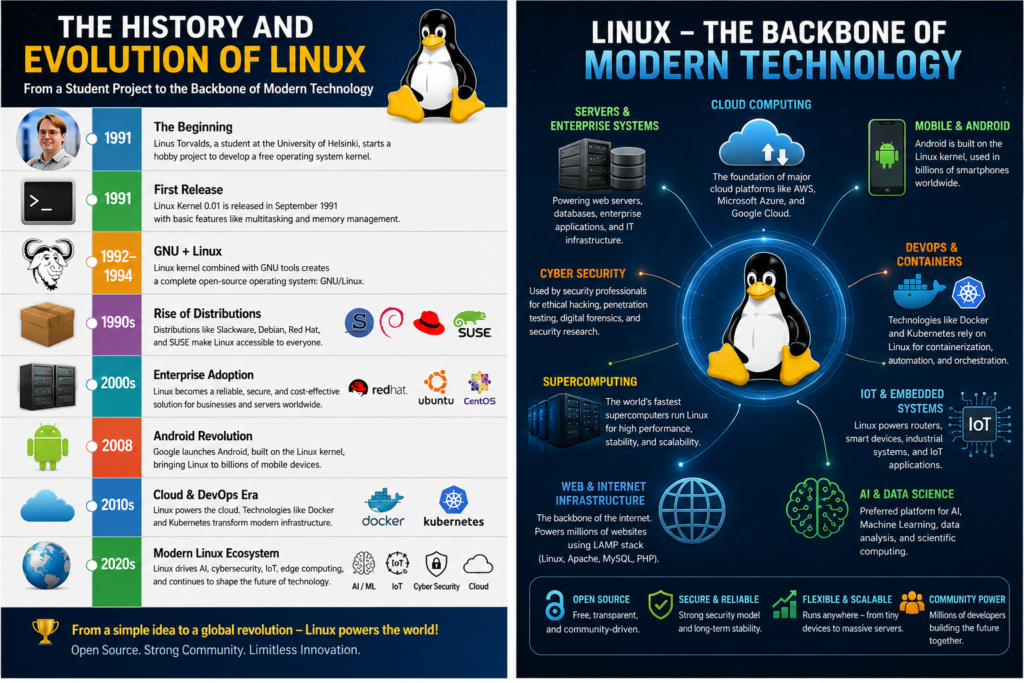
Today, Linux powers:
- Enterprise servers
- Cloud computing platforms
- Android smartphones
- Supercomputers
- Cyber security systems
- Data centers
- Internet infrastructure
- Embedded and IoT devices
From startups to global enterprises, Linux has become the foundation of modern digital transformation.
The Origin of Linux
The journey of Linux started in 1991 when Linus Torvalds, a computer science student at the University of Helsinki in Finland, began developing a free and open-source operating system kernel. At the time, Unix operating systems were expensive and mostly restricted to commercial and academic institutions. Linus wanted a lightweight and accessible operating system for personal computers based on Intel 386 architecture.
On August 25, 1991, he announced his project on the Usenet discussion forum with a message that would later become historic:
“I’m doing a free operating system (just a hobby, won’t be big and professional like GNU)…”
What started as a hobby project soon transformed into a global open-source revolution.
Early Development and Linux Kernel Release
The first version, Linux Kernel 0.01, was released in September 1991. Although limited in functionality, it introduced important concepts such as:
- Multitasking
- Memory management
- File system support
- Hardware interaction
Initially, Linux was only a kernel, not a complete operating system.
Its real strength emerged when combined with software tools from the GNU Project developed by Richard Stallman.
The GNU tools provided:
- Compilers
- Command-line utilities
- Libraries
- Shell environments
Together, GNU and Linux created a fully functional open-source operating system commonly known as GNU/Linux.
The Rise of Linux Distributions
As Linux gained popularity during the early 1990s, several organizations and developer communities began packaging Linux with installation tools, utilities, and desktop environments. These packages became known as Linux distributions, or “distros.”
Some of the earliest and most influential distributions included:
- Slackware
- Debian
- Red Hat Linux
- SUSE Linux
These distributions made Linux more accessible for businesses, developers, and home users.
Linux and the Open-Source Revolution
During the late 1990s, Linux became a major symbol of the open-source movement. Organizations realized the advantages of open-source software, including:
- Lower licensing costs
- Flexibility and customization
- Community-driven innovation
- Enhanced security transparency
Major technology companies such as:
- IBM
- Oracle
- Intel
- HP
started investing heavily in Linux development and enterprise adoption.
This period marked Linux’s transition from a community-driven project to an enterprise-grade operating system.
Linux in Enterprise Computing
By the early 2000s, Linux had become a dominant force in enterprise IT infrastructure.
Organizations adopted Linux because of its:
- Stability
- Reliability
- Scalability
- Security
- Cost-effectiveness
Several enterprise-focused Linux distributions emerged, including:
- Red Hat Enterprise Linux
- Ubuntu
- CentOS
- Fedora
Linux quickly became the preferred operating system for:
- Web servers
- Database servers
- Networking systems
- Hosting platforms
- Enterprise applications
Linux and the Internet Boom
The rapid growth of the internet further accelerated Linux adoption.
Linux became the backbone of web hosting and internet services through the popular LAMP stack:
- Linux
- Apache HTTP Server
- MySQL
- PHP
This open-source technology stack powered millions of websites globally and played a crucial role in the growth of e-commerce, online services, and digital businesses.
The Android Revolution
A major turning point in Linux history occurred in 2008 when Google launched Android.
Android, built on the Linux kernel, revolutionized the smartphone industry.
Today:
- Billions of Android devices run on Linux technology
- Linux powers smart TVs, wearable devices, routers, and IoT systems
- Linux has become the most widely deployed operating system kernel globally
This expansion moved Linux far beyond traditional servers and desktops.
Linux in Cloud Computing and DevOps
The rise of cloud computing transformed Linux into the leading operating system for modern infrastructure.
Major cloud providers including:
- Amazon Web Services
- Microsoft
- Google Cloud
depend heavily on Linux-based systems.
Linux also became central to:
- Containerization
- Virtualization
- Automation
- DevOps practices
Technologies such as:
- Docker
- Kubernetes
further strengthened Linux dominance in modern cloud-native environments.
Linux in Cyber Security
Linux is widely regarded as the preferred operating system for cyber security professionals.
Security-focused distributions such as:
- Kali Linux
- Parrot Security OS
are extensively used for:
- Ethical hacking
- Penetration testing
- Digital forensics
- Vulnerability assessment
- Security research
The flexibility and transparency of Linux make it ideal for building secure computing environments.
Linux in Supercomputing
Linux dominates the supercomputing industry worldwide.
Most of the world’s fastest supercomputers run Linux because of its:
- High performance
- Stability
- Scalability
- Customization capabilities
Linux plays a critical role in:
- Scientific research
- Artificial intelligence
- Space exploration
- Weather forecasting
- Advanced simulations
Modern Linux Ecosystem
Today, Linux continues evolving rapidly and remains at the center of modern technological innovation.
Current areas where Linux plays a major role include:
- Artificial Intelligence (AI)
- Machine Learning (ML)
- Cloud-native infrastructure
- Edge computing
- Cyber security automation
- DevSecOps
- Internet of Things (IoT)
Linux is no longer just an operating system; it has become the foundation of global digital infrastructure.
Key Milestones in Linux History
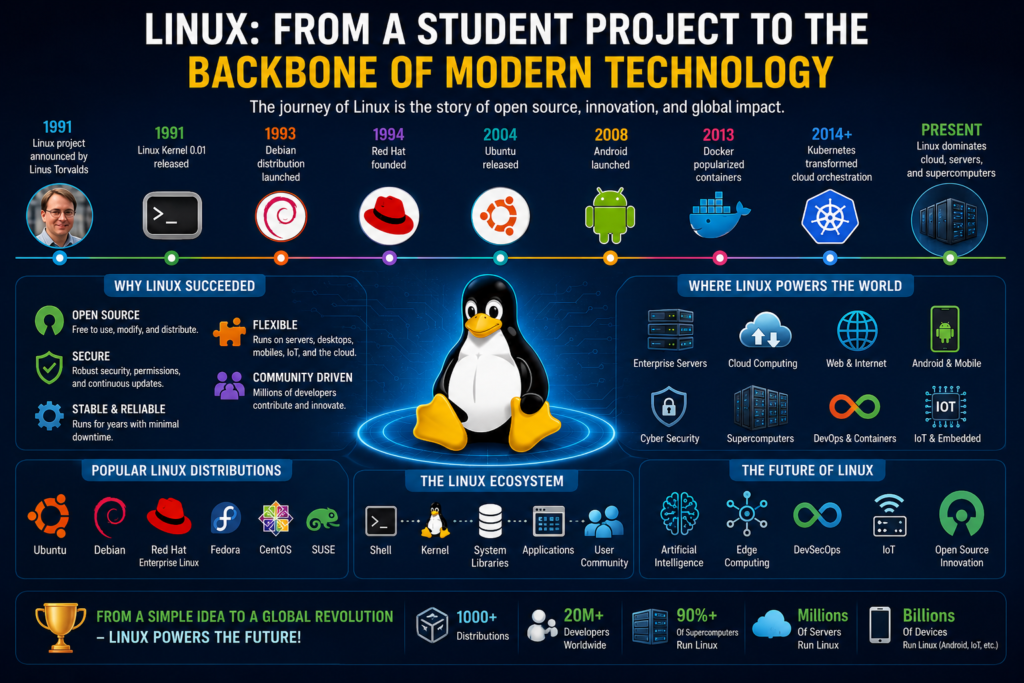
| Year | Milestone |
| 1991 | Linux project announced by Linus Torvalds |
| 1994 | Linux Kernel 1.0 released |
| 1993 | Debian distribution launched |
| 1994 | Red Hat founded |
| 2004 | Ubuntu released |
| 2008 | Android launched |
| 2013 | Docker popularized containers |
| 2014+ | Kubernetes transformed cloud orchestration |
| Present | Linux dominates cloud, servers, and supercomputers |
Why Linux Became So Successful
Several factors contributed to Linux’s global success:
Open Source Philosophy
Linux source code is freely available for modification and distribution.
Strong Security
Linux offers robust permissions, security controls, and frequent updates.
Stability and Reliability
Linux systems can operate continuously for long periods without downtime.
Flexibility
Linux can run on:
- Servers
- Desktops
- Smartphones
- Embedded devices
- Cloud infrastructure
Community Support
Millions of developers worldwide contribute to Linux development and innovation.
The Future of Linux
The future of Linux remains extremely promising as global demand grows for:
- Cloud infrastructure
- Artificial intelligence
- Automation
- Cyber security
- Edge computing
- Open-source technologies
Linux is expected to remain a critical platform for modern enterprise computing and digital transformation initiatives worldwide.
Conclusion
From a simple student project in 1991 to becoming the backbone of the modern internet and enterprise infrastructure, Linux has transformed the technology industry forever.Its open-source nature, stability, scalability, and continuous innovation have made Linux one of the most successful software projects in history.
Today, Linux powers everything from smartphones and cloud platforms to cyber security systems and supercomputers — proving that open collaboration and innovation can shape the future of technology.